

Fill in the brief  ↗EN

Case study · Shopify commerce · USA-first

How We Built the NEBŌ Shopify Jewelry Store and Scaled It from 80 to 400+ Product Listings

The NEBŌ Diamonds team came to us with an objective: prepare the brand for the US market and launch an international Shopify store. At Impress, we designed the commerce system and scaled its catalog from an initial brief of up to 80 ready-to-buy pieces to more than 400 product listings.

In its public positioning, NEBŌ Diamonds describes itself as a lab-grown diamond jewelry brand built around Smart Luxury: distinctive design, transparent value and a calmer buying experience without the traditional luxury retail markup. We built a commerce system around that positioning, connecting jewelry catalog architecture, mobile UX, Google Merchant feeds, AI-assisted visuals and Klaviyo lifecycle email. After the first launch, we continued developing it as the client added new requests and we tested real customer journeys.

NEBŌ Diamonds Shopify storefront on desktop and mobile
NEBŌ Diamonds · Shopify storefront
01

Project at a Glance

Client
NEBŌ Diamonds
Category
Lab-grown diamond jewelry
Platform
Shopify
Market
International, with a USA-first commercial context
Catalog
Initial brief of up to 80 ready-to-buy pieces; 400+ public product listings today
Core work
Jewelry catalog architecture, storefront UX, mobile QA, Google Merchant compatibility, AI-assisted visual production and Klaviyo lifecycle email
Delivery model
Initial commerce foundation followed by ongoing post-launch development
02

The Initial Brief

The first goal was to build an international Shopify store that could:

  • position NEBŌ as a premium brand rather than a generic jewelry catalog;
  • make ready-to-buy pieces easy to discover and purchase;
  • explain the value of lab-grown diamonds;
  • support categories, metals, ring sizes and product configurations;
  • prepare for localization, regional currencies and payment methods;
  • leave room for future catalog growth.

The starting brief included the homepage, catalog, collections, product detail pages, policies, shipping, a product quiz, blog and an email foundation. It set the initial direction rather than a fixed scope: the client regularly added requests and new tasks throughout development. It soon became clear that the real challenge was not the number of pages. It was the product model underneath them.

03

Building a Shopify Jewelry Store Starts With Product Data

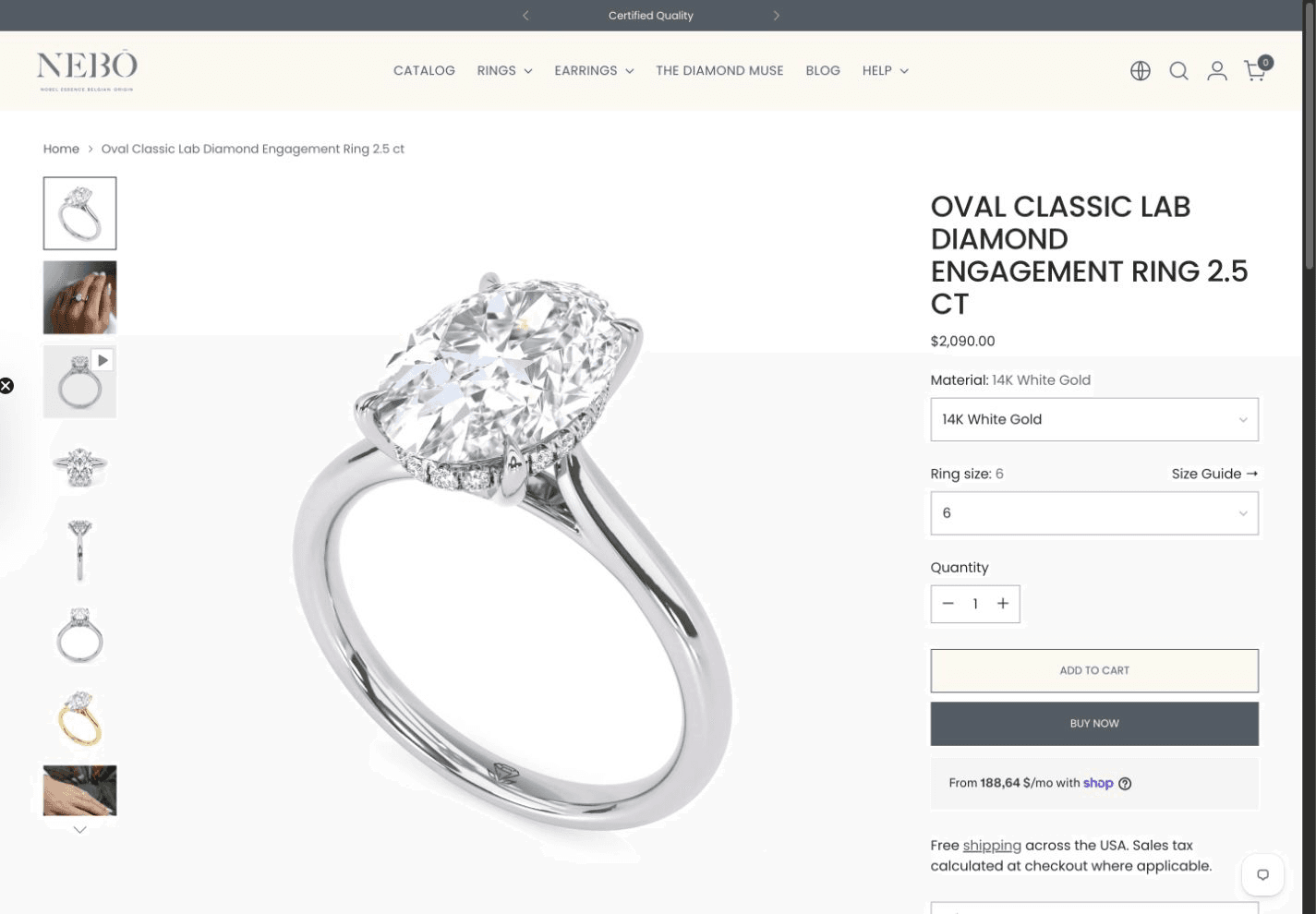
A typical ecommerce product may have a few colors or sizes. A ring can combine a model, metal, karat, metal color, ring size, center-stone shape and carat weight. Each combination can affect the SKU, price, availability and information shown to the customer.

As the catalog expanded, adding more product pages was no longer enough. The store needed a structure that could grow without becoming inconsistent or unmanageable.

nebodiamonds.com
Live NEBŌ Shopify product page with jewelry configuration controls
The live NEBŌ storefront became the visible layer of a larger product and marketing system.
03.01

The Product Decision

We separated the catalog into several layers:

  • the product as a distinct jewelry model;
  • customer-selectable options inside the product page;
  • a unique SKU and price for each purchasable configuration;
  • metafields for filters and additional product attributes;
  • collections and categories for product discovery;
  • URL and product-feed logic for search and shopping channels.

This turned the catalog from a set of pages into an operational product system. New models and attributes could be added without redesigning the storefront every time the assortment changed.

04

Scaling the Jewelry Catalog from 80 to 400+ Product Listings

Catalog growth changed the development process itself. We needed:

  • a standardized source-data template;
  • naming and URL checks;
  • consistent SKU and variant management;
  • collection and filter rules;
  • a repeatable image workflow;
  • QA across the catalog, search, collections and product feeds.

At this scale, a small template mistake can be repeated across hundreds of products. We therefore moved from “check each page” to “validate the rule that creates every page.”

This was a major part of the value we brought to the project: we were not simply populating a store, but helping turn a growing jewelry assortment into scalable commerce infrastructure.

Initial brief80ready-to-buy pieces
Public catalog400+product listings
05

Ring Size UX: Preserving Shopify Variant Logic and Google Merchant Compatibility

One of the most revealing product questions appeared on the ring product page. We first introduced a Choose your size placeholder so customers had to select a size rather than add an accidental configuration to the cart. That solution created a new conflict: after a metal or material change, the price could disappear, the page could look broken, and the absence of a preselected purchasable variant complicated cart behavior and the Google Merchant product feed.

There was no perfect out-of-the-box setting. The decision had to balance three goals:

  1. Make the size decision visible and deliberate.
  2. Keep the price and purchasable variant consistently available.
  3. Avoid extra friction across mobile UX, cart behavior and shopping channels.

We revisited option order, placeholder behavior and add-to-cart validation, testing the experience on real devices. We ultimately removed the placeholder and restored a default size so the price and commercial logic remained stable. Instead of relying on an empty field, we reduced error risk through a visible selector, mobile testing and a dedicated Ring Size Guide. We also kept the native variant logic intact: deep links from shopping channels opened the relevant configuration, while Shopify stayed the source of truth for price and add-to-cart behavior. Ring-size logic became a real product trade-off between error prevention and a frictionless purchase journey.

06

Protecting Premium Perception While Adding Promotions

A new ecommerce brand needs mechanisms that attract and recover customers: a welcome offer, promotional logic, a popup and abandoned-checkout communication. For a jewelry brand, however, excessive urgency and visual noise can reduce perceived value.

The technical layer was equally important. Shopify prices, compare-at prices, Discount Ninja and shopping feeds needed to remain consistent. Promotions had to display correctly without delaying prices or sending contradictory product data to external channels.

We therefore treated promotion logic as a system:

  • the source of base and promotional pricing;
  • offer display rules;
  • product and collection exclusions;
  • cart and checkout behavior;
  • mobile performance;
  • fit with the brand's premium positioning.

In the final architecture, native Shopify price and compare-at price data became the source of truth for product feeds, while the promotion app handled only the offer-display scenarios that did not conflict with that logic.

Some solutions were simplified or rebuilt after testing. A ready-made Shopify app can provide functionality, but it cannot decide how that functionality should affect brand perception, product data and the customer journey.

07

AI as the Foundation of Visual Production — With Extensive Manual Work

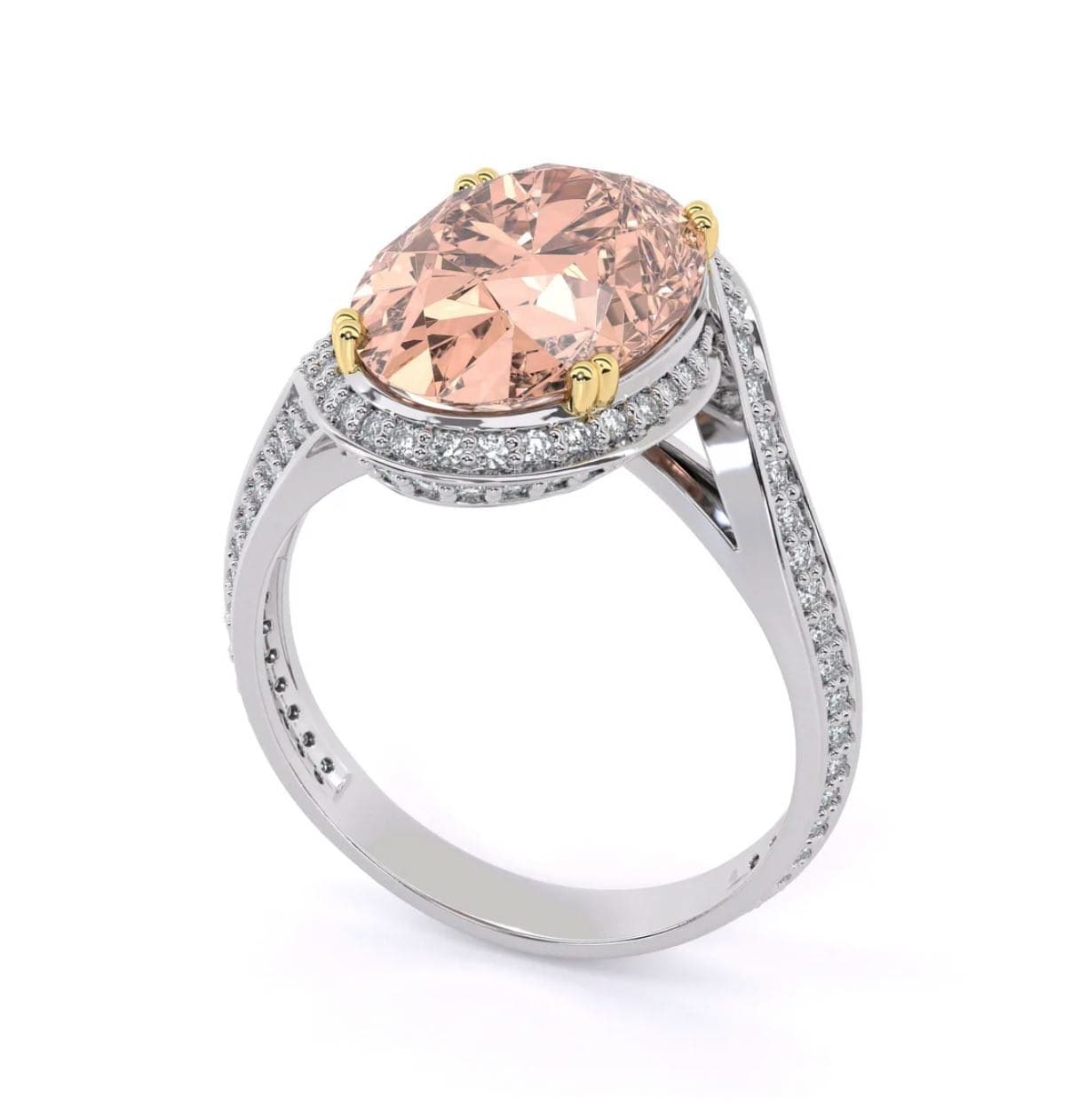
We created all project creatives, covers and product visuals with AI. Most of this work took place in late 2025 and early 2026, when generation tools still had significant limitations: they could provide a strong compositional base, but rarely delivered accurate jewelry, anatomy and fine detail without our intervention.

AI therefore did not replace our production process; it became the first stage of it. We manually refined almost every image after generation: correcting the jewelry, metal and gemstone, repairing hands and skin, and rebuilding separate elements in Photoshop. We later reassembled or regenerated some completed frames when we saw an opportunity to improve them.

In jewelry, a visually attractive AI image is not enough. We still had to validate:

  • product shape and proportions;
  • gemstone cut and depth;
  • metal reflections and placement;
  • scale against the hand;
  • skin, fingers, nails and anatomical detail;
  • fit with the brand's restrained, cool-toned visual system.

This was not a critical process failure. For AI production at that time, several iterations were normal. A frame could start with a strong hand-and-product composition, then require another pass on the hands, another product-placement review and a final reconstruction before approval.

Close-up jewelry visual created for NEBŌ with AI and manual refinement
NEBŌ ring campaign visual after AI generation and manual product refinement
Editorial earring visual created for the NEBŌ storefront
AI-assisted visual production: generated foundations, then manually refined product details, anatomy, light and materials.
07.01

What the Working Process Looked Like

The working cycle looked like this:

  1. Produce a small test set.
  2. Review hands, lighting, angle and overall feeling.
  3. Manually refine the jewelry, skin and individual details in Photoshop.
  4. Regenerate or rebuild frames that could be improved.
  5. Approve the current version and continue scaling, with further iterations where needed.

AI provided speed and variation, while substantial manual work protected product truth. Almost every final image required hands-on refinement because premium jewelry imagery cannot rely on a beautiful composition alone: the product, material, lighting, scale and anatomy all need to feel convincing.

08

Launch Was the Start of the Next Phase

The store was opened for real-device testing in January. This was not the end of the project. It was the transition into mobile QA, performance fixes, pricing and option validation, localization, cart behavior and checkout refinement.

Post-launch development included:

  • continued catalog expansion;
  • product-feed compatibility work for Google Merchant;
  • wishlist and return-to-product journeys;
  • cart and checkout improvements;
  • a separate indexable Ring Size Guide with international size conversions and a mobile-first table;
  • branded Shopify notifications;
  • tracking through Shopify Customer Events and a Custom Pixel;
  • Microsoft Clarity and a CRO backlog;
  • campaign-specific storefront updates.

Where the store lacked an authoritative calculation source, we did not simulate precision. For example, we rejected an approximate tax calculator without a reliable API or backend logic: in checkout, no calculation is safer than a convincing but potentially inaccurate one.

The project therefore had two major parts: building the commerce foundation and evolving the product after the first launch.

09

Jewelry Ecommerce Email Marketing as Part of the Shopify System

Lifecycle email should be integrated when an ecommerce store launches, not postponed until later: subscriptions, product views, cart activity, checkout and purchase create valuable first-party signals from day one. Without an operating lifecycle layer, the brand cannot respond to those signals at the right time and loses opportunities to bring back visitors who have already shown intent.

Industry benchmarks and our own practice show that automated email journeys can generate around 30% of email-attributed revenue even though automation messages represent only a small share of sends. That is why the email foundation should be built from the start, before the store begins losing valuable signals and audiences that have already shown intent.

NEBŌ's email marketing was not designed as a series of occasional newsletters. It was meant to continue the customer journey after a store visit: introduce a new brand, answer objections, return customers to selected pieces and support them after purchase.

09.01

Map Behavior Before Designing Emails

We defined the core lifecycle scenarios:

ScenarioEventCommunication role
Welcome SeriesCustomer subscribesExplain Smart Luxury, the product and the brand's value
Browse AbandonmentViews a product and leavesReturn to a specific piece without aggressive pressure
Abandoned CartAdds a product but does not start checkoutRemind and reduce hesitation when the contact is known
Abandoned CheckoutStarts checkout but does not finishReturn to the closest available purchase point
Post PurchasePlaces an orderConfirm the choice and provide useful guidance
Customer WinbackBecomes inactive after purchaseRe-open the relationship carefully

Wishlist, failed-payment, delivery-update and review-request scenarios were developed as additional layers. The map defined the lifecycle architecture, while finished layouts and inbox previews verify that the core emails were actually built and tested.

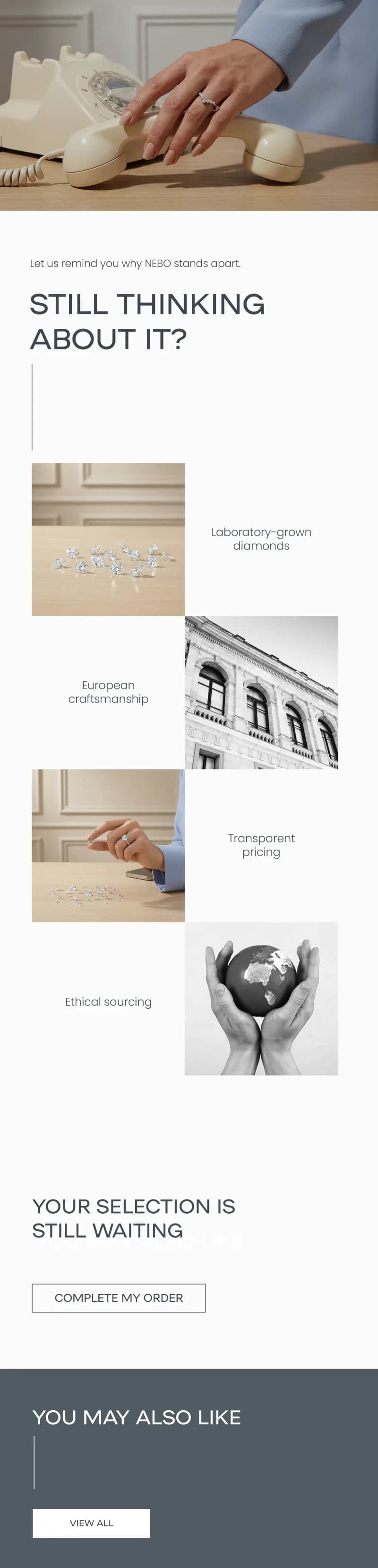
NEBŌ Welcome Series email layout
Welcome Series
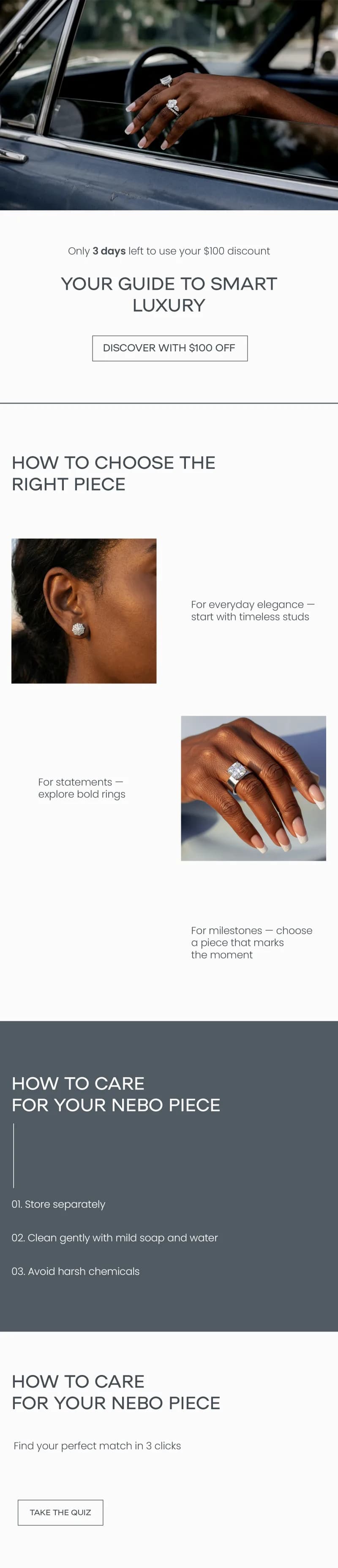
NEBŌ abandoned-cart lifecycle email design
Cart Recovery
NEBŌ lifecycle nurture email layout
Nurture
Selected assets from the operating Klaviyo lifecycle system.
09.02

Why Cart and Checkout Required Different Logic

In Shopify, an Added to Cart event does not always include an email address. If a visitor is not signed in, has not subscribed and has not entered contact information, Klaviyo does not know who should receive the message. A Started Checkout event is more likely to contain an email and is therefore more reliable as the primary recovery trigger.

That platform constraint changed the flow architecture. Instead of promising abandoned-cart recovery for every visitor, we separated the situations:

  • a known contact can be recovered after the cart;
  • an unknown contact only enters the email system after subscribing, signing in or starting checkout;
  • recovery flows should follow the priority Failed Payment → Abandoned Checkout → Abandoned Cart → Wishlist;
  • filters should prevent overlapping offers and contradictory messages from reaching the same customer.

This is where email marketing becomes product and technical work, not only copywriting.

09.03

A Welcome Series That Does More Than Discount

For a new jewelry brand, an offer alone is not enough. The Welcome Series was structured as four sequential touchpoints:

  1. An introduction to NEBŌ, Smart Luxury and the welcome offer.
  2. Lab-grown diamonds, the brand's stated Antwerp production and transparent pricing.
  3. Customer stories and the emotional context of choosing jewelry.
  4. Selection and care guidance, product recommendations and a final offer reminder.

The objective was not to turn a considered purchase into a discount impulse, but to create several useful, brand-consistent touchpoints. Full branded layouts were prepared for all four emails and test messages were reviewed in a mobile inbox.

09.04

From Flow Map to Testable Customer Journeys

Beyond the welcome sequence, we built and reviewed customer-facing emails for several moments in the journey:

  • two Abandoned Cart emails: a direct reminder about the saved product, followed by brand arguments and a return-to-checkout prompt;
  • Browse Abandonment: a second look at the specific viewed piece, supported by the Smart Luxury proposition;
  • Post Purchase: a thank-you message, care guidance and a clear support path;
  • Customer Winback: a feedback request after a period of ownership and a restrained repeat-purchase offer.

This meant the email system was checked as more than copy or static editor screens. Test sends made it possible to review the real mobile inbox experience, hierarchy, dynamic product blocks, calls to action and template length. The described lifecycle flows were implemented, activated and are operating in Klaviyo; separate performance metrics are not disclosed in this case.

09.05

The Technical Email Layer

The work extended beyond strategy and design:

  • Klaviyo and Shopify integration;
  • corporate-domain sender identity;
  • email authentication;
  • an onsite subscription popup;
  • flow triggers, filters and priorities;
  • dynamic product content;
  • mobile email QA;
  • Shopify notification testing;
  • deliverability and subscription-logic review.

One important trade-off involved double opt-in. Strict confirmation protects list quality and sender reputation, but adds another step and can prevent many potential subscribers from reaching the Welcome Series. After reviewing subscriber behavior, the logic was adjusted: deliverability safeguards remained, while unnecessary friction was reduced.

09.06

Turning Shopify Notifications into Brand Touchpoints

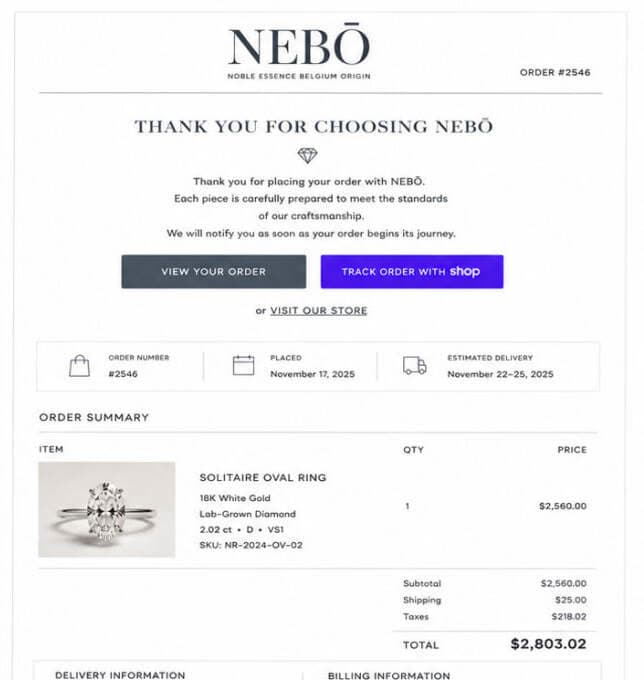
Standard Shopify notifications perform a technical function, but they do not automatically continue the premium storefront experience. NEBŌ therefore received a unified direction for order and shipping communication: logo, typography, order structure, trust blocks, delivery information and mobile behavior.

Before applying the system across all notifications, we approved a visual direction and tested a real email in the inbox. This reduced the risk of reproducing one design or code issue across every Shopify notification template.

Branded NEBŌ Shopify order notification
Approved order-confirmation direction used to test the shared Shopify notification system.
09.07

The Popup as Part of the Same Lifecycle

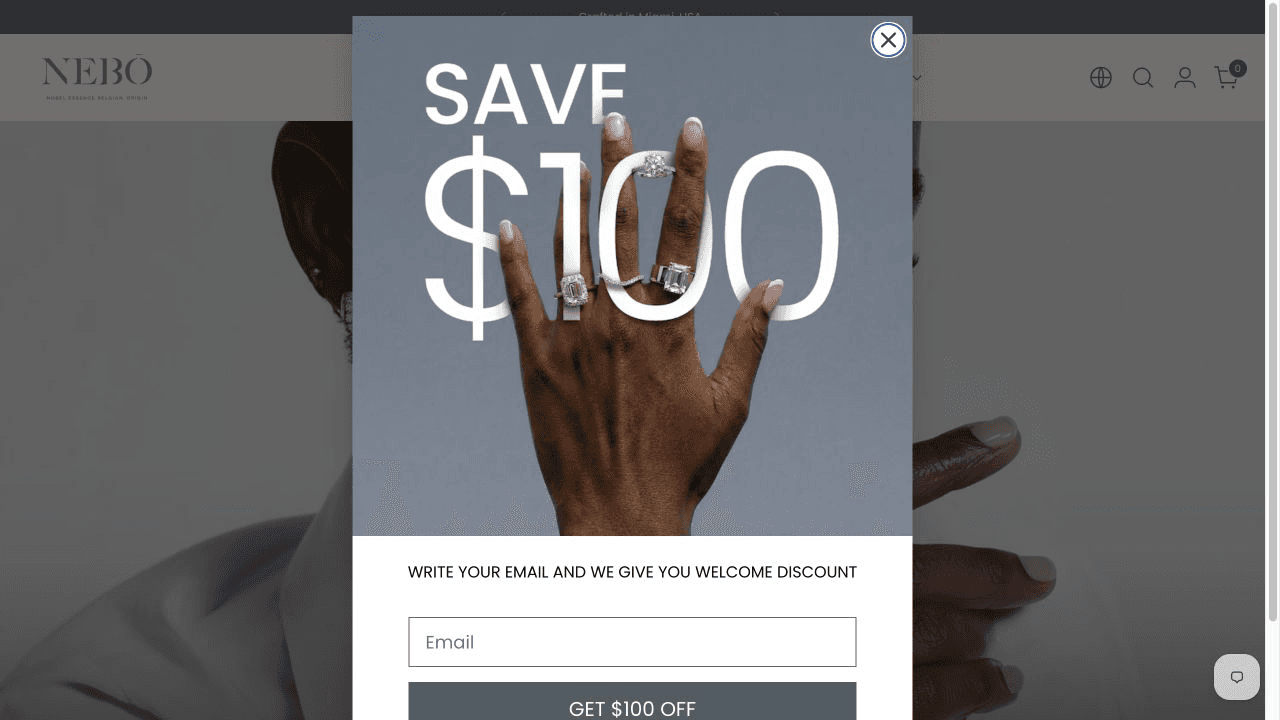
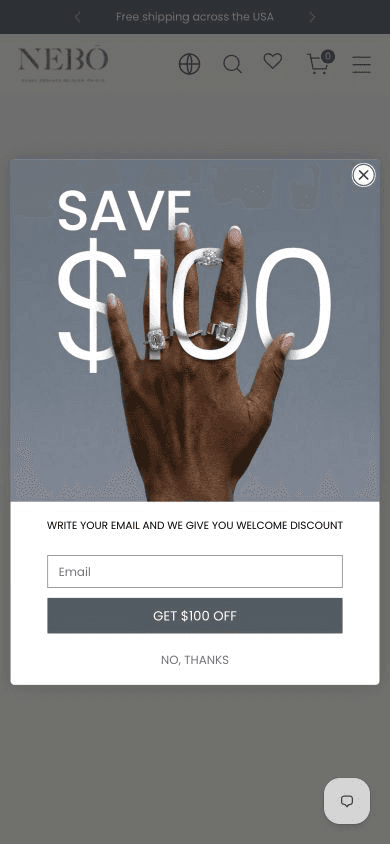
The final popup connects the onsite journey with the Welcome Series: the customer sees a clear offer, shares an email address and enters the lifecycle system. Both the modal and its teaser needed desktop and mobile QA so they would not cover key commercial elements of the page.

NEBŌ subscription popup on desktop
NEBŌ subscription popup on mobile
The onsite popup was tested for desktop and mobile as part of the same lifecycle journey.
10

The Result: A Shopify Commerce System Built for Continued Growth

The project evolved beyond a one-off Shopify build into a growing commerce system:

  • more than 400 public product listings;
  • scalable products, variants, SKU and metafield logic;
  • jewelry-specific collections, filters and product discovery;
  • mobile-first selection and purchase journeys;
  • an AI + Photoshop visual workflow with an approval gate;
  • an operating Klaviyo lifecycle architecture, activated lifecycle flows and branded Shopify notifications;
  • a foundation for localization, campaigns and further CRO;
  • an ongoing post-launch product-development process.

The most important output was not the number of installed apps. It was the decision-making between speed and quality, automation and control, promotion and premium perception, platform constraints and real customer behavior.

11

What This Means for Other Jewelry Brands

If a brand has a large assortment, complex product configurations or international plans, selecting a beautiful Shopify theme is not enough. It needs a team that connects the storefront, product data, content, lifecycle communication and customer journey — and continues improving that system after launch.

At Impress, we work with jewelry and premium brands at the intersection of ecommerce, marketing, AI production and product thinking.

Discuss a Shopify or ecommerce project for your jewelry brand →

12

Questions founders and ecommerce teams ask us

FAQ

01

Why is Shopify suitable for a jewelry ecommerce store?

Shopify provides a relatively fast route to an international storefront, payments, Markets, product feeds and an established app ecosystem. A large jewelry catalog still requires a custom product, variant, metafield, size and filter architecture.

02

How should a large jewelry catalog be structured in Shopify?

Separate the jewelry model from the purchasable configuration, standardize SKU and source data, define variant and metafield logic, and connect it to collections, filters, URLs and product feeds. Bulk uploading without a product model only scales inconsistency.

03

How can a store reduce incorrect ring-size orders?

The size decision should be highly visible, but an empty required selector is not the only way to reduce error risk. If it disrupts pricing, cart behavior or the shopping feed, the store can retain a default size, strengthen the selector and Ring Size Guide, and test the entire journey on real mobile devices.

04

Why use Klaviyo for a jewelry brand?

Klaviyo connects Shopify events with lifecycle communication across welcome, browse, cart, checkout, purchase and winback scenarios. For a high-consideration jewelry purchase, that creates multiple opportunities to build trust without relying on constant discount pressure.

05

Can AI be used for jewelry product imagery?

Yes, when AI is one part of a controlled production workflow. Product shape, gemstone detail, metal, scale, skin and lighting still require validation, and product truth often requires manual Photoshop work.

06

Does ecommerce development end when the store launches?

No. Launch reveals real-device performance, selection errors, cart and checkout friction, localization issues, email deliverability and visitor behavior. For ecommerce, launch is the transition from building to managed product iteration.

Impress × ecommerce

A beautiful storefront is only the visible layer. We build the system beneath it.

Discuss a Shopify or ecommerce project